
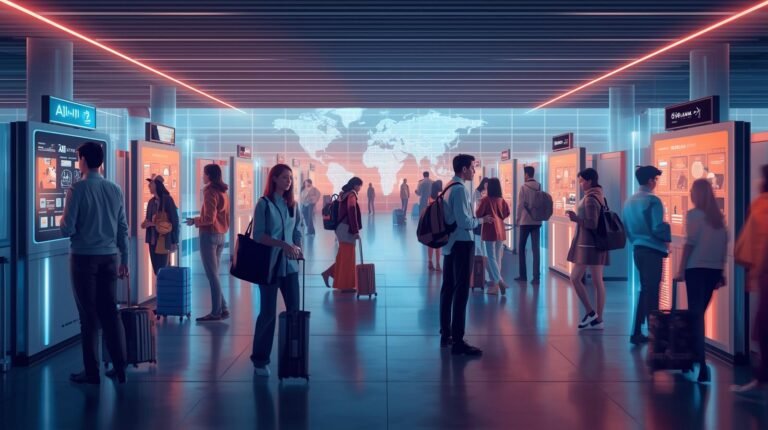
The aviation industry stands at an inflection point. For decades, the passenger journey has been defined by friction: long queues, repetitive identity checks, generic service, and disconnected touchpoints. Today, AI passenger experience technologies are fundamentally rewriting this narrative. By combining artificial intelligence with biometric travel solutions and data-driven personalization, airports and airlines are creating seamless travel journeys that adapt to individual passengers in real-time.
This transformation goes beyond operational efficiency. It represents a fundamental reimagining of how travelers move through the aviation ecosystem, from booking to baggage claim, with technology that anticipates needs, removes barriers, and delivers consistently exceptional experiences.
The Foundation: Understanding AI Passenger Experience Transformation
The traditional passenger journey involves an average of eight distinct touchpoints where travelers must present identification, boarding passes, or other credentials. Each represents a potential delay, confusion point, or source of frustration. Passenger experience AI addresses this by creating a digital thread that connects every interaction while eliminating redundant processes.
Modern AI systems achieve this through three core capabilities:
AI Personalization in Airport Passenger Journey: Beyond Generic Service
Personalization in travel has evolved far beyond addressing passengers by name in email communications. Modern AI-driven personalization for airline customer experience creates individualized journeys that recognize each traveler as unique, with distinct preferences, constraints, and priorities.
Consider the business traveler who consistently books aisle seats, prefers morning flights, and rarely checks baggage. AI systems identify these patterns and proactively surface relevant options during booking. At the airport, smart airport technology recognizes their arrival patterns and suggests optimal parking locations based on terminal, time, and walking distance preferences.
The family traveling with young children experiences an entirely different journey. The system identifies their needs, proximity to restrooms, family-friendly dining options, play areas near their gate, and delivers timely wayfinding assistance. Push notifications alert them to shorter security lines or suggest timing that minimizes wait exposure with children.
This level of personalization extends throughout the journey. AI analyzes factors including:
Historical booking patterns and seat preferences • In-flight service selections and dietary restrictions • Loyalty program status and reward preferences • Connection timing and stress indicators • Ground transportation patterns • Post-flight destination types and timing
The system synthesizes these data points to create personalized travel recommendations powered by AI that feel intuitive rather than intrusive. The distinction matters: passengers increasingly expect relevant service, but reject experiences that feel surveilled or manipulative.
How Biometrics Improve Passenger Experience at Airports: The Identity Layer
Airport biometrics solve one of travel's most persistent pain points: repetitive identity verification. The average international passenger presents their passport and boarding pass between six and ten times during a single journey. Each verification slows progress and creates queue bottlenecks.
Biometric identity verification for airline passengers collapses these multiple checks into a single enrollment. Passengers opt in, typically at check-in or through a mobile app, by providing a facial image that becomes their travel token. From that moment, their face becomes their boarding pass, their ID, and their key to moving seamlessly through the airport.
The technology has matured considerably. Modern facial recognition travel systems achieve accuracy rates exceeding 99% in controlled airport environments, even accounting for variables like aging, glasses, or cosmetic changes. More importantly, they operate at scale, processing passengers in under two seconds per verification point.
Implementation typically follows this flow:
Leading airports deploying touchless check-in biometrics passengers airport solutions report dramatic results: security processing time reductions of 30-40%, boarding time cuts of up to 50%, and passenger satisfaction scores that consistently exceed traditional processes.
End-to-End Passenger Journey Using Biometrics and AI: Orchestrating Seamless Flow
The most powerful implementations don't treat AI and biometrics as separate initiatives. Instead, they integrate both into a unified seamless travel experience through AI and biometrics that transforms the entire journey.
Here's how this orchestration works in practice:
Pre-Airport: The passenger receives an AI-generated itinerary that accounts for their location, traffic patterns, and historical arrival timing. The system recommends an optimal departure time and sends reminders calibrated to their preferences, some passengers want multiple alerts, others prefer minimal notifications.
Arrival and Check-In: Facial recognition identifies the passenger upon entering the terminal. If they have bags to check, the system directs them to an available bag-drop location with minimal queue. Digital identity travel credentials eliminate the need for physical document presentation. The bag tag prints automatically, linked to their biometric profile.
Security Processing: TSA PreCheck or similar programs already provide expedited security for approved travelers. Biometric integration eliminates the need to present boarding passes or IDs at this checkpoint. The passenger walks through, their identity confirmed via facial recognition, their eligibility for expedited screening verified automatically.
Retail and Services: As the passenger moves through the terminal, the AI system tracks their progress toward their gate. If they have ample time, it might surface dining recommendations based on their preferences and dietary restrictions. If they're running late, it prioritizes wayfinding and sends gate information prominently.
Boarding: At the gate, passengers approach the biometric camera and walk through, no fumbling for phones or scanning paper passes. The system verifies their identity, confirms seat assignment, and tracks boarding completion in real-time. This contactless travel experience accelerates boarding while providing airlines precise data on passenger location and flow.
In-Flight: For carriers with advanced systems, the AI journey continues onboard. Flight attendants access passenger preference data, favorite beverages, entertainment selections, dietary needs, enabling more personalized service. The system never shares sensitive personal information, but surfaces relevant service preferences.
Arrival and Connections: Upon landing, connecting passengers receive real-time guidance: gate information, walking time estimates, whether they have time for a quick meal. The AI considers their movement speed, terminal layout, and buffer preferences when offering recommendations. For international arrivals, biometric systems expedite customs and immigration processing.
Smart Airport Passenger Flow Optimization with AI: Managing Complexity at Scale
Individual personalization matters, but airports must simultaneously optimize for thousands of passengers with competing needs and constraints. Smart airport passenger flow optimization with AI addresses this system-level challenge.
Traditional airports operate somewhat reactively: queues form, staff respond, and passengers experience the delays. AI-enabled airports shift to predictive, dynamic management:
Capacity Modeling: The system continuously models checkpoint capacity against predicted passenger volumes. It accounts for flight schedules, historical flow patterns, special events, and real-time variables like weather delays or equipment failures.
Resource Allocation: Based on these models, AI recommends optimal resource deployment. This might mean opening additional security lanes during predicted peak periods, redistributing staff to bottleneck areas, or adjusting gate assignments to balance passenger distribution across the terminal.
Proactive Communication: Rather than waiting for passengers to encounter congestion, the system sends proactive alerts. Passengers approaching the airport during peak periods might receive suggestions to use less crowded security checkpoints. Those already in the terminal get real-time updates on wait times and alternative routes.
Predictive Problem Resolution: AI identifies emerging issues before they cascade. If a large flight delay will suddenly release 300 passengers into the terminal during an already-busy period, the system alerts operations teams and adjusts resource allocation preemptively.
This system-level intelligence works in concert with individual personalization. While the AI optimizes overall flow, it simultaneously delivers personalized guidance to each traveler, balancing individual needs against collective efficiency.
AI in Airline Operations Enhancing Passenger Satisfaction: The Operations Connection
Passenger experience doesn't exist in isolation from operations. Flight delays, gate changes, baggage issues, and other operational disruptions disproportionately drive dissatisfaction. AI in airline operations enhancing passenger satisfaction creates resilience that directly improves experiences.
Disruption Management: When operational issues occur (weather delays, maintenance problems, crew scheduling challenges), AI systems rapidly develop alternative solutions while prioritizing passenger impact. The technology can simultaneously rebook hundreds of affected passengers, considering connection requirements, seat preferences, and loyalty status, in minutes rather than hours.
Baggage Intelligence: Lost baggage remains one of travel's most frustrating experiences. AI systems track bags throughout their journey, predict potential misconnections, and proactively reroute when necessary. When issues do occur, passengers receive automatic updates and precise delivery timelines rather than uncertainty and queue waits.
Crew Optimization: AI-driven crew scheduling ensures adequate staffing while accounting for skill sets, regulatory constraints, and service quality requirements. Better crew scheduling means fewer delays and more consistent service delivery, operational efficiency that passengers experience as reliability.
Maintenance Prediction: Predictive maintenance systems identify potential aircraft issues before they cause delays or cancellations. This operational capability translates directly to higher completion factors and better schedule integrity, metrics passengers experience as dependability.
The connection between operations and experience creates a virtuous cycle. AI systems that optimize operations reduce disruptions. Fewer disruptions mean less passenger stress and higher satisfaction. Better experiences translate to loyalty and revenue, justifying continued investment in AI capabilities.
Implementing AI Passenger Experience: Practical Considerations for Aviation Leaders
For aviation executives considering these technologies, several strategic considerations determine success:
Data Ecosystem Integration: Effective passenger experience AI requires data flowing between multiple systems: reservations, operations, customer relationship management, loyalty programs, and airport infrastructure. Airlines and airports with fragmented legacy systems face integration challenges. The solution often involves creating a data layer that unifies information without requiring wholesale replacement of existing platforms.
Privacy and Trust: Biometric and AI systems process sensitive personal data. Success requires transparent communication about what data is collected, how it's used, and what control passengers maintain. The most successful implementations provide clear opt-in mechanisms, allow passengers to review their data, and enable opt-out at any time. Trust isn't just ethical, it's practical. Passengers who trust the system engage more fully and provide more accurate preference data.
Interoperability Standards: As individual airports and airlines deploy solutions, industry-wide standards become critical. A passenger who enrolls in biometric travel at one airport should ideally use that enrollment across their entire journey, even when connecting through different airports or traveling on different carriers. Industry initiatives addressing these standards are progressing, though universal adoption remains years away.
Human Touch Balance: AI and biometrics excel at reducing friction and automating routine processes. They struggle with exceptions, complex problems, and emotionally charged situations. The best implementations pair automated efficiency with readily available human assistance. Passengers need clear pathways to reach knowledgeable staff when AI systems can't resolve their needs.
Phased Deployment: Successful implementations typically follow a crawl-walk-run approach. Initial phases might focus on single touchpoints, biometric boarding, for instance, or AI-powered mobile assistant features. As systems mature and integration improves, capabilities expand to more comprehensive journey orchestration.
Measurement Framework: Aviation leaders need clear metrics to evaluate AI passenger experience investments. Useful measurements include: checkpoint processing time reduction, passenger satisfaction scores at specific touchpoints, operational efficiency gains, revenue impact from personalized offers, and system adoption rates. The most valuable implementations create measurable improvements across multiple dimensions.
The Convergence Ahead: Where AI Passenger Experience Is Heading
Current implementations, while impressive, represent early stages of what's possible. Several emerging trends will shape the next evolution:
Multimodal Journey Integration: Today's systems typically focus on the air travel portion of passenger journeys. Future implementations will extend earlier, connecting with ground transportation, parking, and even trip planning, and later, integrating with destination services, hotels, and return journeys. The vision is comprehensive travel orchestration from door to door.
Emotion Recognition and Well-being: Advanced AI systems are beginning to detect emotional states through voice tone analysis, facial expressions, and behavioral patterns. While privacy concerns require careful implementation, these capabilities could identify stressed passengers who would benefit from proactive assistance, or recognize medical emergencies before they escalate.
Hyper-Personalization Through Federated Learning: Current personalization relies on centralized data collection, raising privacy concerns. Federated learning techniques allow AI models to learn from passenger data without that data ever leaving the passenger's device. This approach could enable sophisticated personalization while giving passengers complete data control.
Autonomous Ground Operations: AI-driven autonomous vehicles, baggage systems, and aircraft servicing will further streamline ground operations. These capabilities reduce delays and improve consistency, operational benefits passengers experience as reliability and speed.
Biometric Ecosystem Expansion: As airline personalization and biometric systems mature, they're expanding beyond airports. Immigration and customs agencies are adopting biometric exit programs. Hotels and car rental companies are exploring facial recognition check-in. The eventual vision: a trusted identity that follows travelers throughout their entire journey, eliminating repetitive credential presentations.
Predictive Well-being Services: Future AI systems may proactively identify passenger health or comfort needs. Long-layover passengers might receive suggestions for rest areas or shower facilities. Passengers showing signs of flight anxiety could be discreetly offered assistance or upgraded to more comfortable seating when available.
The Strategic Imperative: Why Aviation Leaders Must Act Now
The aviation industry has historically been conservative, often waiting for technologies to fully mature before adoption. This approach made sense when capital expenditures were massive and integration was complex. Modern AI in aviation technologies are different, often deployable in phases, measurably beneficial in early stages, and rapidly improving through operational learning.
Several factors create urgency:
Competitive Differentiation: As early adopters demonstrate measurable success, passenger expectations are shifting. Airlines and airports delivering seamless, personalized experiences create preference advantages. Organizations that lag risk being perceived as outdated or impersonal.
Operational Resilience: Aviation faces persistent challenges: staffing constraints, capacity limitations, and increasing passenger volumes. AI and biometric systems help manage these pressures, enabling airports and airlines to serve more passengers with existing infrastructure.
Revenue Opportunities: Effective personalization drives ancillary revenue through relevant, timely offers. Passengers who feel understood and valued demonstrate higher loyalty and lifetime value. Better experiences translate directly to commercial performance.
Workforce Evolution: Staff shortages affect virtually every aviation segment. AI systems that automate routine transactions free employees to focus on high-value interactions requiring empathy, problem-solving, and relationship building. This shift improves both operational efficiency and job satisfaction.
Data Network Effects: AI systems improve through usage. Early adopters accumulate data and operational learnings that compound over time. Organizations that delay entry face increasingly steep catch-up challenges as competitors' systems mature.
The question for aviation leaders isn't whether AI and biometrics will transform passenger experience AI in their sector, that transformation is already underway. The question is whether they'll lead the change or scramble to catch up as competitors and passengers move ahead.
Building the Foundation: First Steps Toward Transformation
For organizations ready to advance their seamless travel journey capabilities, a pragmatic roadmap accelerates progress while managing risk:
Assess Current State: Conduct honest evaluation of existing systems, data capabilities, and integration readiness. Identify the friction points passengers experience most acutely. Map current touchpoints and evaluate which offer highest-value opportunities for AI or biometric enhancement.
Define Strategic Vision: Articulate what success looks like in three to five years. How will passengers experience your services differently? What operational metrics will improve? What competitive advantages will you establish? Clear vision guides tactical decisions and maintains focus through implementation challenges.
Start with High-Impact Use Cases: Identify opportunities delivering measurable value quickly. Biometric boarding often provides clear wins: faster processing, happier passengers, better data. AI-powered customer service chatbots can reduce call center volume while improving resolution speed. Success with targeted implementations builds organizational confidence and funding for broader initiatives.
Invest in Data Infrastructure: Neither AI personalization nor biometric systems function well without solid data foundations. Prioritize integration capabilities, data quality improvement, and privacy-compliant storage. This infrastructure work is less glamorous than passenger-facing applications but absolutely essential for success.
Build Cross-Functional Teams: Effective AI passenger experience initiatives require collaboration across IT, operations, customer service, marketing, and security functions. Create dedicated teams with clear accountability and resources. The best implementations pair domain experts (who understand passenger needs and operational constraints) with technical specialists (who understand AI and system capabilities).
Pilot, Measure, Learn: Launch controlled pilots with clear success metrics. Collect quantitative data (processing times, satisfaction scores, adoption rates) and qualitative feedback (passenger interviews, staff observations). Use learnings to refine approaches before scaling. The iterative approach reduces risk while accelerating learning.
Communicate Transparently: Keep passengers informed about how systems work, what data is collected, and what benefits they'll receive. Transparency builds trust, the foundation for adoption and engagement. Address concerns directly rather than assuming passengers will embrace changes without explanation.
Conclusion
The convergence of AI, biometrics, and smart airport technology represents more than incremental improvement to aviation operations. It's a fundamental transformation of how passengers move through the travel ecosystem, from fragmented, friction-filled processes to intelligent, personalized, seamless journeys.
The organizations leading this transformation understand that technology serves a larger purpose: creating travel experiences worthy of the extraordinary nature of flight itself. When done well, AI and biometrics don't feel like technology at all. They feel like an aviation industry that finally recognizes passengers as individuals, anticipates their needs, and removes unnecessary barriers between them and their destinations.
The revolution in AI passenger experience isn't coming. It's here. Forward-thinking airlines and airports are already delivering these capabilities to millions of passengers. The question for every aviation leader is simple: will you lead this transformation, or will passengers and competitors leave you behind?
The technology is here. The business case is proven. The passenger expectation is established. The only remaining variable is organizational commitment to embrace change and reimagine what passenger experience can be.
The future of aviation extends beyond the simple transportation of passengers between destinations. It is focused on designing travel experiences that are seamless, personalized, and intuitive, minimizing complexity and enhancing the overall quality of the journey.
